
Put That Back! Read This BEFORE You Add That Umpteenth Planner to Cart
In case you didn’t know by now, even the perfect-planner for you may exist but it’s not without the systems that make it all work.
I know—we want THE ONE. The holy grail planner that satisfies every one of our needs, newsflash, only Jesus can do that, but we search endlessly for a match to our personality, helps us meet deadlines, and maybe does everything for us the seller claims including help us with mind blowing productivity.
Pump those breaks. After years of hunting (and purchasing more planners than I care to admit), here’s the truth and let’s be clear, even as I endeavor to make the “perfect planner” to sell, yes, I have always wanted my own planner and I will soon have two that I created on my own. My Author Life Planner is one, and number two will be out in the near future. The thing to remember is that your ultimate planner, is just ONE tool. So many people selling you a planner, are omitting the thing the planner is about 10-40 % of, a SYSTEM. One caveat, some people are showing you their SYSTEM with the planner they happen to sell in the form of a free class, and it’s often included or free. This is a wonderful bonus and I feel like Kudos are due to those influences/companies. Others are like, “here $ 70 buck planner, poof, life fixed, and thanks. Bubye.”
Once you understand your system, you’ll pick a planner that fits into the system and THAT makes it awesome, makes it work for YOU.
• Now that you know there is no perfect planner – you’ll think about the way you organize instead of buying all the things – trust me, I know, and do NOT make any mistake, I still buy all the things because ya girl is very reward oriented and honestly for me, it’s for two reasons: 1. It’s part tax write-off for the research and building my own version, and 2. I also LOVE giving stuff away. I buy it, honestly, I do buy it all, often knowing that I’ll run a giveaway or something and also give a prize every night of my writer retreats.
• What does exist is a system that you have brokered to go along WITH that almost perfect planner – for myself, I use a mix of weekly planner pad, Google calendar (mostly used on my desktop) paper lists (I’m VERY listee) and my smart devices. I’ve since added Notion and ChatGPT to the mix.
Here’s a little run down on how I’m using those aforementioned things in a SYSTEM. You have a system just so you know and I encourage you to write it down so you can see a better visual of what is and isn’t working.
These days, my planning life is a beautifully blended ecosystem. I mix:
1. Paper planner? I actually stopped using it, because I put most everything in Google Calendar right away, I no longer carry a lot of things around when I’m out, (this is more a physical issue/not at all a planner issue). But, I am often just using my phone to see in real time if I have a conflict when scheduling something while I’m out.
2. I do use my own Writing Planner that I created to go alongside my Author Life Fix book I released in 2023- Because of the FTE, I personally don’t need a daily planner because nothing much changes during the day. I use my work calendar during work hours and I am writing mostly nights, and weekends. I love Sunday Starts btw. I often have book related workshops and signings on Saturday and that is one of the reasons I like to look at a full month, so nothing creeps up on me.
3. A handwritten to-do list (always) – not everyday but once a week, and for big projects, and I must make a list on Sunday night or Monday morning at the latest. When I don’t make a list for the week, I feel out of sorts, usually am not as productive as I should be. By the way I wish I could say my list are neatly in ONE notebook but they’re not. Usually it’s a sheet of paper, and I think I get a kick out of tearing them and throwing them away. There’s probably some deep psychological meaning there but I’m not touching that one.
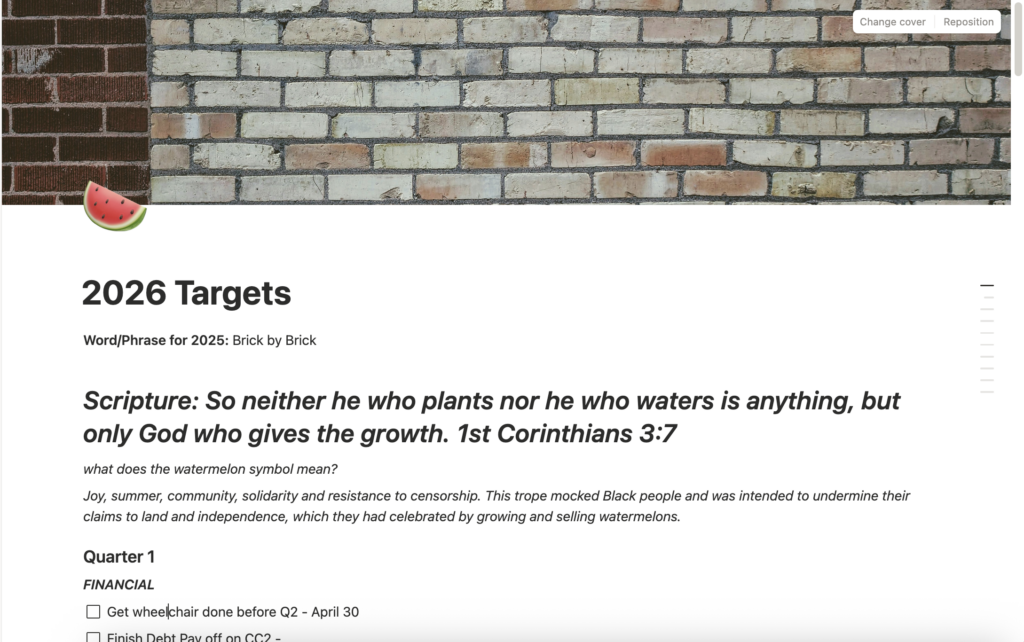
4. Notion (mostly for brain dumps and lists). I also do my goals here.
5. ChatGPT (my brainstorming partner + virtual assistant – helps me write just a little faster, helps with marketing copy and list making of the stuff I often forget).
6. Smart Devices like Alexa (also like a virtual assistant). In the mornings I usually ask her for reminders for meetings for the entire day, if I have a meeting at Noon, I’ll ask her to set the alarm for 11:50 am. When I’m in deep work, this ensures the alarm rings, and I stop and do what I need.
7. My new favorite thing that I added last year is a weekly page. This has kind of replaced the paper planner in that I will write all the appointments for the week and it sits under my computer monitor, front and center. I usually staple four or five pages together for the entire month. I can also look back on the months to see easily what I did and didn’t accomplish because I checked it of (or not). These list pads I use I get from like this sone here Day Designer. Seeing what I did and didn’t get done for the week is often a fun little boost. I also will keep them for a few months so I can use them for reflection, goal setting and carry over any still relevant tasks that didn’t get done.
Here are some additional Tips for choosing a planner. First, If you’ve got a relatively good planning system going, Writer-Specific Planners Are Also a Thing:
As an author, I’ve tried several planners made especially for writers. I don’t always use story planners, but I do love planners that help me get my writing/creative thinking done.
Here’s some writing themed planners I’ve reviews on IG for:
Susie May Warren’s, My Brilliant Writing Planner
Mandi Lynn’s Book Launch Planner (check out her YouTube deep dive)
Audrey Hughey’s Writing Planner
They’re are plenty so please know I’m only naming a few.
Now—let’s talk about choosing the “best” planner”… or rather, the best planner to add to your system.
1. If You’re Unsure, Don’t Buy—Download Free First, (don’t just blow the funds unless you really want to try it and the online pictures are exciting you).
If you’re experimenting or have commitment issues (planner-wise), start with something free, inexpensive, or printable.
Most planner companies offer sample pages online. Print a few, clip them together, disc-bind them or put them in a three-ring binder. You can also spend just spend $10–$20 bucks to have them coil-bind at Staples, Office Depot or any office supply place with a print shop. Give it a two-week or one-month trial. No heartbreak, no wasted money.
You could also try something from the store, e.g., office supply like Stapes and Office Depot or random planners you find at Ross, TJMaxx, and Marshall’s are gems for test runs.
And if you need a monthly calendar RIGHT NOW and want to be frugal, check out this incredible list of organizations that will mail you free calendars—plus digital versions you can download.
2. Know Your Planning Style (Daily? Weekly? Monthly? Hybrid? Sunday/Monday Starts/Holidays, or No?)
This part probably matters more than anything else. Many people believe their week starts on Sunday and many believe it starts on Monday and that’s fine. What day do YOU start? That’s all that matters. With that said, I’m a Sunday-start person. I am absolutely a Monthly-Only planner person. I want big boxes, space to write appointments at a glance, (and I like lines in my boxes, which there are FEW planners with lines in the box-work on that people!) I like the ability to see everything coming up so nothing sneaks up on me during Week Four.
3. Memory Keepers & Scrapbookers: You Need a Specific Type of Planner
If you love stickers, embellishments, mini photos, washi tape, and turning your planner into an art project? Great. For you a planner is more about the scrapbooking of your big, beautiful life. You’ll refer to it in years to come to remember when. That’s a beautiful thing.
4. When All Else Fails: Go Custom, Franken Plan or Start a Bullet Journal
Franken Planning simply means you take a Frankenstein approach and build your own customization, which is usually a combination of lots of different planners, ripped apart but keeping the pieces you use, love and need. You can see a many a version of this on YouTube. This is a great way to get everything you want by combining and customizing, almost like a planner buffet. However, the drawback is that you usually can’t put a year’s worth of every page you use into it, meaning you might have to break it up. If you are able to fit it all into one planner, the weight of it once you’re done, can be a turn off. You won’t be bringing Franken with you on the go.
Where ChatGPT and Notion have added to my mix.
I’ve only used Notion and ChatGPT for the last year, Notion a little longer use of the two. Really getting into Notion and really having CHAT assist with ideation and planning marketing, blogs and content for my workshops has ben so much time saved.
I wish I could say with Notion that I’ve learned how to use it for dashboard, memory keeping, some kind of financial tracker and support, etc., but it’s more of a long-term memory keeper in that I use it for annual big picture planning, goal setting and quarterly big picture things. I also use it like a diary-light, too. I’ll do some monthly reflections at the end of each month. What I love about it, is keeping things, and any lists I’ve made, I can access it anywhere. The blend of all of these tools keeps my creative life going, is truly fun and not a time suck when used properly, and most important, I rarely jump on organizational trends that fizzle out in a few months. Find something that you can stick with and that will really only improve as more adopters get onboard.
The Perfect Planner Is the One You Use COMBINED with a Robust System.
Tweak part of the system NOT just the planner. Remember they should all work together and try to update one aspect that’s causing difficulty and not seek to upend all parts of the entire thing.
If your system works—even if it’s weird, mismatched, scribbled, or hybrid and/or some analog—it works. That’s all that matters.
Tracee Lydia Garner is a book coach supporting authors and aspiring writers with their work, from ideation and writing practice, to publishing and uploading to retailers. Email: hello@traceegarner.com to learn more about her coaching packages.
Disclaimer: Nothing in this post is sponsored. No affiliate links. No compensation from any planner company mentioned.